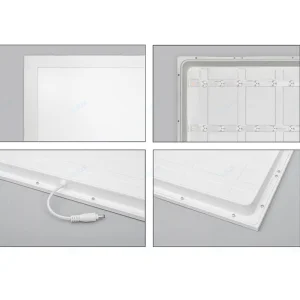
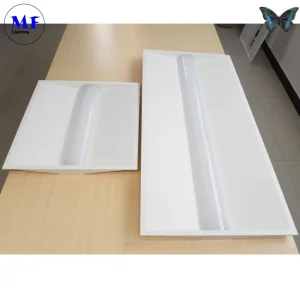
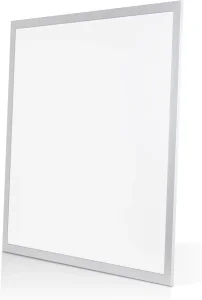
High-efficiency, flicker-free ceiling solutions designed for strict UGR compliance across modern corporate settings.
Understanding the physics of Unified Glare Rating (UGR) and its measurable impact on workplace productivity, cognitive strain, and environmental health.
The Unified Glare Rating (UGR) is an empirical formula specified by the CIE (International Commission on Illumination) to evaluate psychological glare in indoor environments. Calculated based on the luminance of the luminaire, background luminance, and the observer's viewing angle, achieving UGR < 19 is the benchmark for office desks where computer tasks are performed. Lower indexes such as UGR < 16 are implemented for higher cognitive concentration levels like design studios or intensive data monitoring rooms.
Persistent exposure to glare forces the human visual system to contract pupil muscles continuously, leading to asthenopia (eye strain), headaches, and premature physical fatigue. In modern workspace design, human-centric lighting (HCL) prioritizing low UGR profiles is crucial. Limiting direct line-of-sight exposure to LED light sources boosts employee comfort and directly translates to a reduction in operational errors and absenteeism.
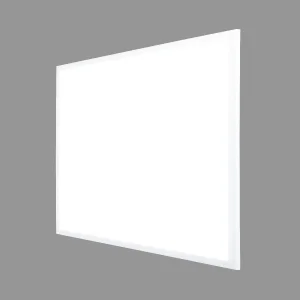
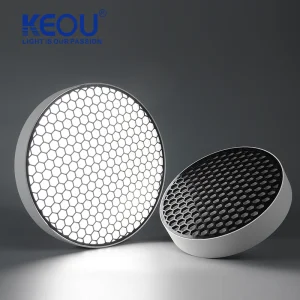
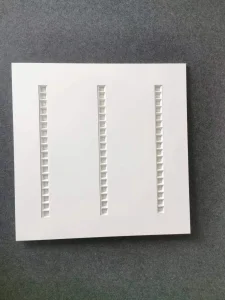
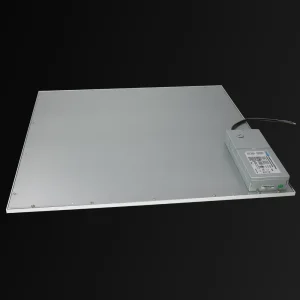
Standard diffusers scatter light uniformly in all directions, causing high-angle light to strike eyes directly. Our advanced office ceiling panel lights implement micro-prismatic structures (MPRs). These precision-embossed PMMA sheets redirect light rays into a narrower downward cone (typically <65 degrees), optimizing lux levels directly on target work surfaces while cutting off distracting lateral glare.
How high-grade polymers, structural aluminum, and robust driver electronics combine to prevent thermal degradation and visual output depreciation.
We utilize professional optical PMMA (Polymethyl Methacrylate) instead of low-cost PS (Polystyrene) for all edge-lit light guide plates. PMMA features a light transmittance of up to 92%, exceptional structural stability, and absolute resistance to UV-induced yellowing over a typical 50,000-hour operational cycle. This ensures the output spectrum remains pure and maintains correct color temperature (CCT) profiles over years of continuous operation.
Thermal management is the single most critical factor in mitigating LED lumen depreciation. Our fixtures are housed in precision-machined 6063 anodized aluminum frames. With a high thermal conductivity of ~200 W/m·K, these rigid frames serve as a comprehensive heat sink, drawing heat rapidly away from the SMD modules. This protects light emitting junctions and prolongs the lifespan of internal driver components.
Flicker (even invisible, high-frequency light modulation) causes neurological fatigue and headaches. We deploy constant-current drivers designed with a ripple factor of less than 1%. Certified by international standards including CE, ROHS, SAA, LVD, and EMC, our drivers prevent stroboscopic effects under high-speed video recording and support various dimming protocols such as 0-10V, DALI, and smart wireless integrations.
| Performance Parameters | Architectural Grade (Low UGR) | Standard Office LED Panel | Impact on Building Systems |
|---|---|---|---|
| Unified Glare Rating (UGR) | < 16 to < 19 (Microprismatic Optics) | UGR > 22 (Opal Diffuser) | Complies with EN 12464-1 workspace standards |
| LGP Material Type | PMMA (Polymethyl Methacrylate) | PS (Polystyrene) | Zero yellowing, matches building design lifespan (50k hrs) |
| Flicker Index & Ripple | < 1% (True Flicker-Free Driver) | > 5% to 8% (Standard Driver) | Reduces visual fatigue, camera flicker-free |
| Frame Material | 6063 Aircraft-grade Aluminum | Sheet Metal / SPCC Steel | Optimized heat dissipation, prevents structural warping |
| Dimming Capability | DALI, 0-10V, DIP Switch Power Selector | Fixed Output Only | Enables daylight harvesting and smart building interface |
Leveraging our advanced manufacturing facility to deliver cost-efficiency, strict quality control, and rapid logistical dispatch.
To control component tolerances and unit costs, we operate dedicated injection molding, blister molding, and compression molding workshops. Maintaining complete ownership of physical tooling enables rapid customization for bespoke client requirements, shortens structural prototyping loops, and limits supply chain risk. Our independent mold research and development center operates at the core of our technical capabilities.
Reliability is confirmed through scientific testing. Our facility houses an internal darkroom and is equipped with integrating sphere spectrometers, goniophotometers, IP65/IP66 waterproof rating testers, and high-temperature aging chambers. Every production run undergoes rigorous tests to confirm actual luminous flux, CRI (Color Rendering Index), color uniformity, and driver thermal performance under thermal load.
Located just 38 kilometers away from the Ningbo Port—one of the largest deep-water ports globally—our facility offers seamless global shipping. This location minimizes domestic transport costs, avoids traffic bottlenecks in inland hubs, and ensures containerized freight can be cleared and dispatched efficiently to Europe, America, Southeast Asia, Australia, the Middle East, and Africa.
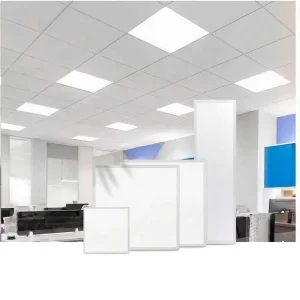
From corporate headquarters to healthcare settings, our versatile low UGR lights are engineered for high-performance installations.
Beyond standard offices, our specialized IP65 and IP66 tri-proof fixtures are engineered for demanding environments. They perform reliably in high-humidity bathrooms, saunas, industrial kitchens, hospitals, bakeries, canteens, military barracks, material warehouses, and heavy manufacturing workshops. They are also suitable for outdoor areas requiring dust and moisture protection, such as subway tunnels, underground parking garages, squares, and docks.
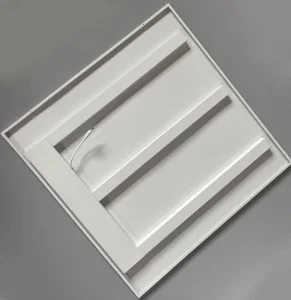
Equipped with a dedicated R&D team, we customize structural housings, drivers, and photometric profiles according to customer drawings and samples. Whether adjusting dimension sizes (60x60, 62x62, 30x120cm), selecting dimming options, integrating emergency battery packs, or tuning color temperatures and beam shapes, our vertically integrated plant allows us to adapt to specific contract specifications.
To ensure smooth customs clearance and regulatory compliance on building sites worldwide, our company holds BSCI certification and ISO9001:2000 quality management system approval. Our catalog has received certifications from recognized testing houses, including TUV, GS, CE, ROHS, LVD, and EMC. We continually update our certifications to meet evolving environmental and product safety standards.
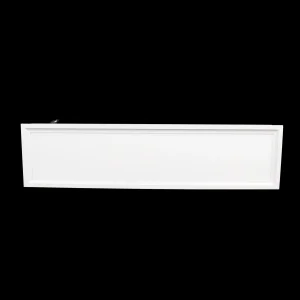
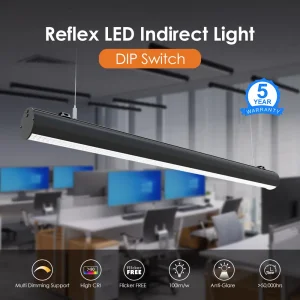
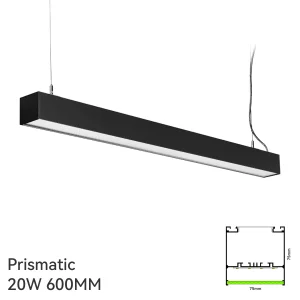
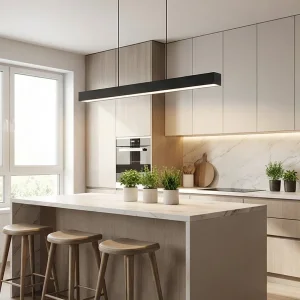
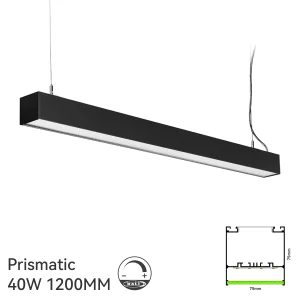
Flexible linear systems and adjustable configurations designed for modern office spaces, schools, and commercial properties.
Answers to technical and logistical questions for electrical engineers, procurement departments, and architectural consultants.
We perform UGR verification inside our photometrics darkroom. Using a high-precision goniophotometer, we compile the IES files (illuminating engineering society format) that map the spatial luminous intensity distribution. These files are then simulated in lighting design software such as DIALux or Relux. Using standard room dimensions and surface reflectance profiles (typically 70/50/20 ceiling-wall-floor), we calculate and confirm the UGR index. We provide comprehensive laboratory reports to project engineers upon request.
PMMA (acrylic) is highly resistant to degradation under environmental heat and UV exposure. In contrast, PS (polystyrene) light guide plates often begin to yellow within 12 to 18 months of intensive office use, which shifts the color temperature towards a warmer, lower-quality hue. Our PMMA light guide plates retain their transparency and optical structure, ensuring consistent light distribution and color quality over a 50,000-hour operational life.
We achieve this through vertical integration. By running our own injection molding, compression molding, and blister molding workshops, we minimize outsourcing costs and control dimensional tolerances. This in-house component manufacturing, combined with automated assembly lines, allows us to optimize production costs while ensuring our products meet CE, ROHS, SAA, and TUV standards.
We support structural, electronic, and aesthetic customization. Our R&D team can adapt housing dimensions (such as 595x595, 600x600, 620x620, or linear modules), configure CCT options (3000K, 4000K, 6000K) via physical DIP switches, integrate emergency power packs, and customize dimming options (DALI, 0-10V, or Zigbee/Casambi). We construct and test tooling according to our clients' architectural schematics.
Our manufacturing plant is located just 38 kilometers from Ningbo Port, allowing for rapid transit from factory floor to ocean container. To protect fixtures during transport, we pack them in reinforced corrugated cartons with form-fitting molded pulp end caps and moisture-barrier bags. This packaging is designed to prevent structural damage, scratches, and vibration fatigue during transit.