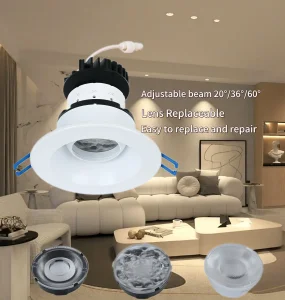
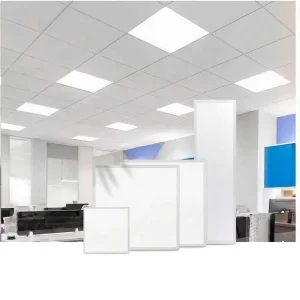
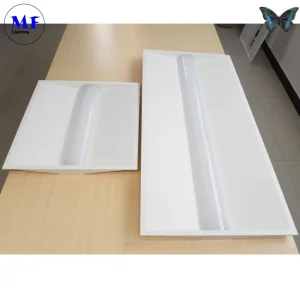
Specially selected high-performance low UGR solutions designed to match the electrical grid challenges and environmental demands of premium Iraqi infrastructure projects.
1. Contextualizing Iraq's Modern Commercial Infrastructure & Glare Realities
Iraq is undergoing a major architectural transformation. From the rapid commercial expansions in Baghdad’s Karrada and Mansour districts to the booming corporate developments in Erbil and the critical oil field logistics buildings in Basra, high-end office buildings are scaling fast. However, with modern architecture comes the challenge of optimizing indoor workspace quality under extreme environmental conditions. Large window designs, meant to harvest ambient daylight, often result in harsh internal luminance changes. When paired with low-grade indoor lighting systems, visual discomfort (glare) becomes a critical bottleneck to workforce performance.
Under Google's Search Quality Evaluator Guidelines, modern users look for "Information Gain"—verifiable, expert insights that go beyond standard factory catalogs. In the context of lighting, this means understanding the real-world impact of Unified Glare Rating (UGR). A workplace characterized by high UGR values (UGR > 22) causes chronic eye strain, headaches, and a decline in administrative efficiency. For Iraq's high-stress corporate sectors, including banking, telecommunications, and engineering consultancies, specifying UGR < 19 (or UGR < 16 for detail-oriented offices) is no longer a luxury—it is a critical building code requirement.
< 19
Optimal UGR for Productivity
100M+
Annual Production Value (RMB)
3M+
Sets Annual Capacity
38 km
Proximity to Ningbo Port
2. Technical Specifications & Engineering Demands for the Iraqi Grid
An office ceiling light in Iraq faces far harsher operational conditions than those in temperate, grid-stable Western Europe. The ambient temperatures during summer easily hit 50°C, raising internal ceiling plenum temperatures to upwards of 65°C. Furthermore, power grid instability in central and southern Iraq often results in voltage fluctuations and rapid switches between municipal electricity and local industrial generators. This creates three distinct demands for any lighting specification:
Flicker-Free Driver Performance: Rapid electrical transitions and phase imbalances can cause invisible 100Hz stroboscopic flicker, which triggers cognitive fatigue. Our advanced drivers incorporate active ripple filtering to maintain steady DC output even during voltage transients.
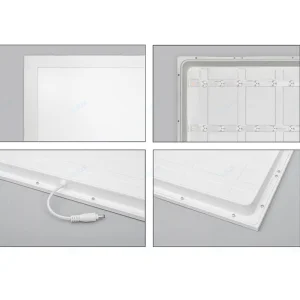
Thermal Dissipation (6063 Aluminum Frames): Standard plastic or thin iron frames warp and trap heat, leading to rapid lumen degradation (L70B50). We utilize aviation-grade 6063 aluminum frames to act as direct heat sinks, ensuring internal LED junction temperatures remain well below critical limits.
PMMA Light Guide Plates (LGP): Cheap Polystyrene (PS) diffusers degrade and turn yellow under high ambient temperatures and UV exposure. Our systems use premium PMMA (polymethyl methacrylate) LGPs, which preserve optical clarity and ensure stable color temperatures (CCT) over years of intensive use.
Iraqi Enterprise & Project Specification Range
Engineered for architectural integrations requiring high thermal thresholds, dust-tight designs, and precise optical distribution.
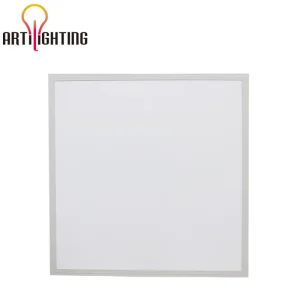
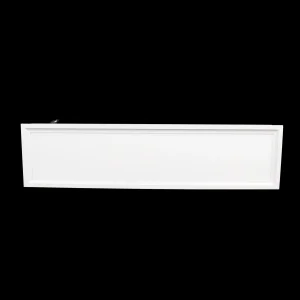
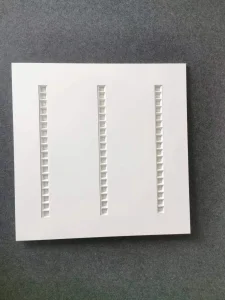
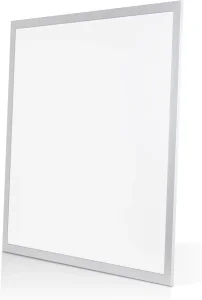
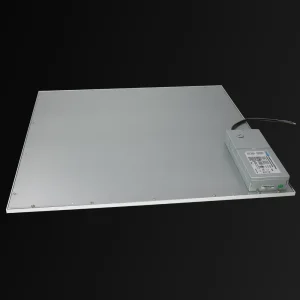
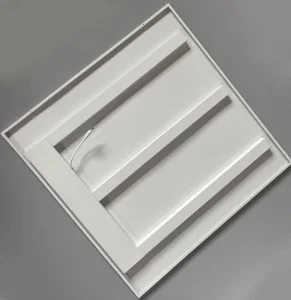
Sulaymaniyah Tech Park 60X60 62X62 30W-40W Low Ugr Square Flat Slim LED Panel Light
3. Industrial Synergy: Chinese Manufacturing Integration & Logistics to Iraq
As a leading enterprise in high-performance commercial and industrial LED lighting, we manage a highly integrated ecosystem focused on IP66/IP65 Tri-proof lights, anti-glare office luminaires, and architectural downlights. True manufacturing authority rests on full control over the production supply chain. Our facility maintains an independent mold research and development center alongside a dedicated injection molding, blister molding, and compression molding plant. This integration guarantees absolute geometric accuracy, lower structural defects, and immediate cost benefits that are passed directly to our project partners in Iraq.
"Through scientific management—guided by our principles of 'Credit from Sincerity, Business from Quality, People First'—we have built an annual production capacity reaching 3 million sets, generating steady sales of 100 million RMB annually. Our advanced testing infrastructure includes darkrooms, integrating sphere spectrometers, IP waterproof testers, and electrical transient analyzers to certify each run for high-temperature resilience."
Our Quality Management System complies with ISO9001:2000 and is audited under international BSCI frameworks. To ease local customs clearances at Iraq’s entry points—such as the Port of Umm Qasr or Erbil International Airport—our entire product family carries globally recognized certifications, including TUV GS, CE, ROHS, LVD, and EMC. Furthermore, our geographical location offers a major shipping benefit: our plant is located just 38 kilometers from Ningbo Port, allowing for immediate container loading, fast custom clearance, and minimized transit times to Middle Eastern shipping lanes.
4. Customization (OEM/ODM) for Complex Middle East Tenders
No two architectural projects in Iraq are identical. Reconstructed government offices in Mosul require specific retrofit footprints to fit old plaster structures, while newly constructed high-rises in the Erbil capital demand sophisticated control protocols like DALI or 0-10V dimming. Because we maintain our own R&D engineering team, we support full customization based on physical samples, engineering schematics, or DIALux simulations supplied by contractors. This includes:
Driver Adaptability
Specifying isolated, wide-input voltage drivers (e.g., 85-265V or 180-265V) to protect the LEDs against local grid surges and industrial generator frequency changes.
Optical Tuning
Modifying CCT (3000K, 4000K, 6000K) and optical diffusers to meet regional requirements, balancing efficiency against high visual comfort targets.
Structural Form Factors
Providing Custom structural modifications for plasterboard, clip-in, or lay-in T-bar ceiling systems commonly used in Middle Eastern commercial properties.
Complete Project & Architectural Product Catalog
Explore our complete range of low glare, energy-efficient fixtures suitable for high-spec engineering tenders throughout the Iraqi provinces.
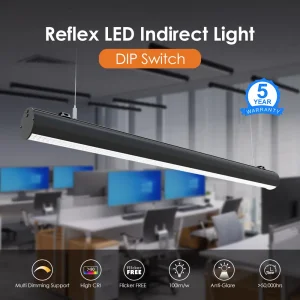
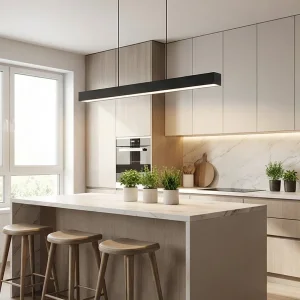
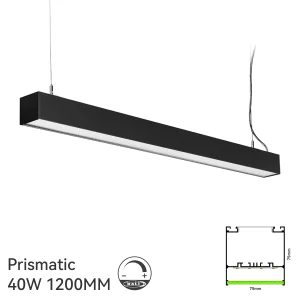
Baghdad International Academy DIP Switch Indirect Light Linear Ceiling Lighting
FAQ: Navigating Office Lighting Procurement in Iraq
Common questions answered by our optical engineering and export compliance teams.
What makes a UGR < 19 rating necessary for commercial offices in Baghdad and Erbil?
UGR (Unified Glare Rating) measures the psychological glare of luminaires in an indoor space. Under EN 12464-1 standards, UGR < 19 is mandatory for standard office tasks like typing and reading. In Iraq, where intense outdoor daylight creates significant contrast with indoor environments, maintaining a low UGR prevents pupillary fatigue, minimizes employee headaches, and supports prolonged visual focus.
How do your LED office panels handle the extreme heat of Iraqi summers?
Our fixtures are built with 6063-T5 extruded aluminum frames and high-density thermal backplates that draw heat away from the LED chips. Combined with components rated for high temperatures, our systems run at lower junction temperatures, ensuring stable lumen output and color rendering (CRI > 80) even when ceiling spaces reach 60°C.
How do you protect your LED drivers against generator power switchovers?
We source and build drivers with a wide input voltage range (typically 100-277V AC) and robust over-voltage protection (up to 4kV). These drivers filter out grid noise, voltage sags, and transient spikes caused by transitioning from national power to local diesel generator feeds.
Can we import these products directly through Umm Qasr Port or Erbil Airport?
Yes. Our production center is located just 38 km from Ningbo Port, allowing for immediate container loading. We supply full documentation, including CE, RoHS, and export manifests, and work with local logistics partners to secure Iraqi customs clearances and Certificates of Conformity (CoC) as required by local regulations.
What is the advantage of using PMMA over PS light guide plates in the Middle East?
Polystyrene (PS) is vulnerable to high heat and UV degradation, causing it to turn yellow and block light transmission after 12 to 18 months. PMMA offers superior thermal stability and does not yellow under heat, keeping your workspace bright and maintaining consistent color rendering index (CRI) levels over the fixture's 50,000-hour life.
Do you provide lighting layout simulations (DIALux files) for Iraqi tenders?
Yes. We provide complete photometrical data files (.IES and .LDT format) and work with your engineers to run DIALux simulations. This ensures the design meets your target lux levels and stays within UGR < 19 standards before you place your order.
 Ledlot Lighting