Sydney Commercial & Industrial Lighting Profile: Standards & Local Realities
The commercial landscape of New South Wales, centered around Sydney CBD, Parramatta, and Macquarie Park, is undergoing an unprecedented architectural transformation. Central to this evolution is the prioritization of occupant wellness, sustainable infrastructure, and energy performance. Commercial office assets are increasingly benchmarked against stringent certifications including the National Construction Code (NCC 2022) Section J, the NABERS Energy rating, and the international WELL Building Standard.
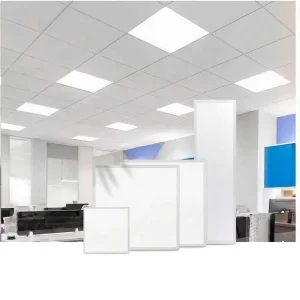
In premium Grade-A office layouts, lighting design is no longer evaluated solely on its luminous flux or baseline energy efficiency. The visual comfort of the working staff plays a critical role in productivity, health, and reducing eye strain. The AS/NZS 1680 standard system governs office and screen-based visual tasks in Australia, setting rigid parameters for glare indices. Traditional lighting grids without specialized control filters often result in excessive reflection, discomfort, and glare—defined globally by a high Unified Glare Rating (UGR). To counter this, modern corporate tenants and electrical consultants in Sydney mandate the implementation of Low UGR Office Ceiling Lights with UGR < 19 for general task zones, and UGR < 16 or UGR < 10 for detailed visual tasks and high-end boardrooms.
UGR <19
General Office Standard
100M+
Annual Production Value
BSCI & ISO
Factory Management Certified
3 Million
Sets Annual Capacity
Information Gain: Unpacking the Optical Physics of Low UGR Panel Engineering
Visual comfort in architectural lighting is controlled by light distribution geometries and the brightness levels within the field of view. Our low glare ceiling luminaires achieve low UGR values through advanced engineering:
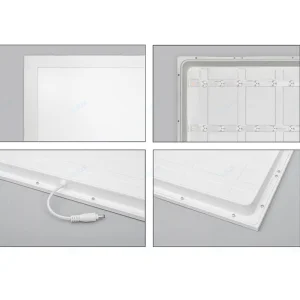
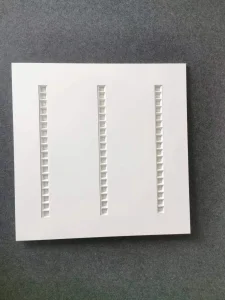
Micro-Prismatic PMMA Diffusers (LGP): Structured optical matrices redirect high-angle glare down towards task surfaces, avoiding lateral scatter directly into human eyes.
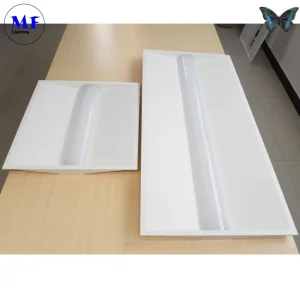
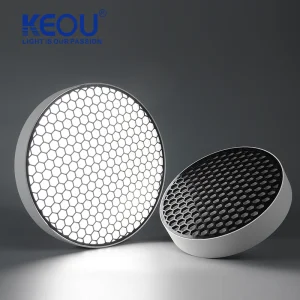
Recessed Mechanical Cutoff: Utilizing deep reflector cups and physical baffles to restrict direct lamp viewing angles, lowering optical output beyond a 65-degree tilt.
Flicker-Free Driver Performance: High-frequency solid-state control circuits ensure ripple-free illumination, satisfying Sydney health and workplace safety criteria by avoiding neurological strain.
Our Scientific and Technical Commitment
We operate an advanced, independent mold research and development center alongside a dedicated photoelectric testing laboratory. Equipped with high-precision darkrooms, integrating sphere spectrometers, and IP rating waterproof test bays, every production run is certified to precise photometric standards. Ledlot Lighting continues to innovate, developing unique core intellectual property that delivers consistent performance to the global commercial market.
Meeting Global Enterprise Procurement Specifications
For multinational asset managers, quantity surveyors, and engineering consultants, sourcing commercial architectural lighting requires high supply reliability, strict compliance, and design versatility:
Custom Design Realization
Backed by an agile engineering team, we develop custom fixtures based on customer sketches or mechanical prototypes to integrate with acoustic baffles or customized ceiling grids.
Cost Control and Vertically Integrated Production
Our facility features in-house injection, blister, and compression molding workshops. Managing our own housing production keeps quality high and unit costs competitive.
High Output & Logistics Proximity
With an annual capacity of 3 million sets, we easily handle large-scale developments. Located just 38 kilometers from Ningbo Port, we ship directly to major ports like Port Botany in Sydney.
Certified Compliance Systems
We are a BSCI-certified and ISO9001:2000 registered manufacturer. Our products carry SAA, CE, GS, RoHS, LVD, and EMC certifications to meet Australian import standards.
Extensive Commercial Lighting Catalog
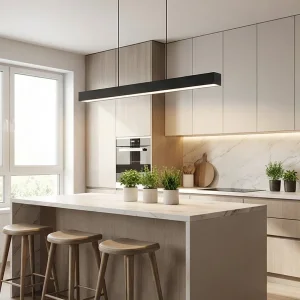
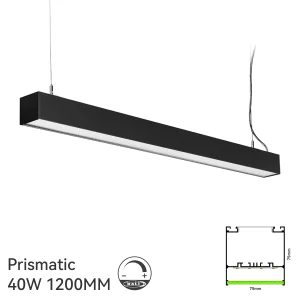
Explore our full line of LED panels, linear track systems, and low-glare ceiling fixtures for Australian commercial offices and industrial facilities.
Manufacturing low-glare office luminaires requires tight tolerances and high-quality materials. LED package performance changes based on thermally induced degradation and optical path structures. Our technical blueprint details how we maintain reliable quality:
1. Advanced Photometric Control & Diffuser Engineering
Standard diffuser plates scatter light in a Lambertian distribution, producing glare at viewing angles above 60 degrees. To prevent this, our office lights utilize micro-replicated PMMA prismatic sheets. Thousands of micro-pyramidal lenses are pressed into the PMMA structure, focusing and redirecting light. This achieves a balance between high visual comfort (UGR < 19) and optical delivery, maintaining an efficiency of over 120 lm/W.
2. Heat Sinks and Thermal Management
Thermal dissipation directly impacts LED chip lifespan (L70B50 lifetimes). We construct our luminaire frames using high-grade 6063 extruded aluminum. This frame acts as a heat sink, transferring heat away from the surface-mounted diode (SMD) arrays. Keeping junction temperatures below 75°C slows lumen depreciation and prevents color shifts, ensuring light consistency in corporate office spaces.
3. High-Performance Driver Designs
Flicker is a common issue in low-quality LED luminaires. It can cause eye fatigue, headaches, and visible strobe effects. Our office panels utilize dual-stage active Power Factor Correction (PFC) drivers. The design maintains a power factor above 0.95 and limits total harmonic distortion (THD) to under 15%. This complies with strict electromagnetic compatibility requirements (EMC / SAA approvals) and provides ripple-free light output.
Do you need certified photometric reports (IES / LDT files) or thermal test data for an upcoming commercial tender in New South Wales?
Tri-Proof Applications in High-Exposure Environments
Beyond standard corporate workspaces, architectural projects often require robust lighting for parking areas, covered walkways, and storage spaces. We manufacture specialized IP65 and IP66 rated Tri-proof luminaires to complement our low-UGR indoor panel lines. Designed to protect against dust and moisture, these fixtures feature high-impact polycarbonate housings and silicon gasket seals, protecting internal components in humid, dusty, or coastal settings.
These Tri-proof models are well-suited for demanding locations such as parking garages, commercial food preparation areas, processing facilities, coastal shipping docks, transport hubs, and underground pedestrian zones. They offer durable performance, protecting against water, dust, and physical impact.
Answers to common technical and compliance questions from electrical consultants, project builders, and commercial estimators.
How is UGR calculated, and why is UGR < 19 required in Sydney offices?
Unified Glare Rating (UGR) is an empirical formula defined by the CIE that calculates the glare of luminaires in a room relative to background brightness. Factors include the observer's viewing angle, fixture luminance, and room layout. In Sydney, AS/NZS 1680.1 recommends a UGR limit of 19 or lower for office-based visual tasks to maintain occupant comfort and prevent eye fatigue.
What is the difference between Edge-lit and Back-lit LED panels regarding UGR performance?
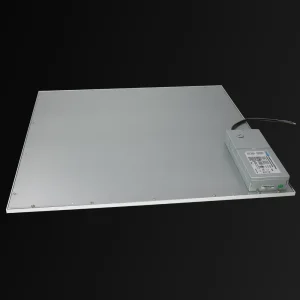
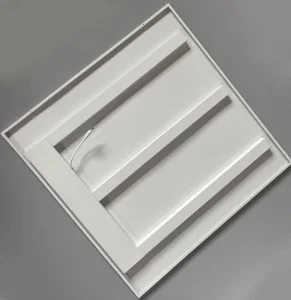
Edge-lit panels direct light from the sides through a light guide plate (LGP), offering a thin profile and uniform output suitable for shallow ceiling voids. Back-lit panels place the LEDs on the backplate, shining light forward through lenses and diffusers. Both designs can achieve UGR < 19, but edge-lit panels are easier to integrate with micro-prismatic sheets for precise glare control.
Do your products hold SAA certification and RCM registration for Australian compliance?
Yes, our export models carry SAA certification, CE, RoHS, and EMC compliance marks. We design and test these fixtures to meet AS/NZS electrical safety standards, making them ready for installation in commercial and industrial settings across Australia.
Can you customize luminaire sizes, finishes, and control drivers?
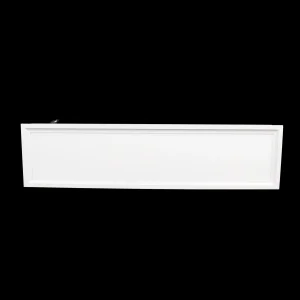
Yes. We provide complete customization services through our independent R&D and injection molding facilities. Options include customized sizes (such as 600x600, 1200x300, 1200x600), customized finishes (including black, silver, or wood-grain), and dimming integration (DALI-2, 0-10V, and Phase-cut).
What is the typical shipping lead time from your factory to the Sydney metro area?
Located 38 km from Ningbo Port, we quickly transition goods from our factory to container vessels. Sea shipping to Port Botany in Sydney typically takes 18 to 25 days, with air freight options available for express sample deliveries.
Ready to start your next commercial office lighting project? Reach out to our engineering team for technical support.
 Ledlot Lighting