Global Quality & Energy Optimization

OEM/ODM Energy Efficient LED Driver Manufacturer & Exporter

Engineering High-Efficiency Solid-State Power Electronics with Advanced Dimming, Maximum Thermal Reliability, and Global Compliance Standards.

Industrial Capacities & Global Footprint

We operate a vertically integrated production line equipped with advanced optical laboratories, precise injection molding machinery, and professional quality control instruments designed to guarantee maximum product lifecycle.

3M+
Sets Annual Capacity
100M+
Annual Sales Value (RMB)
38 km
Proximity to Ningbo Port
100%
In-House Photoelectric Lab Testing
TECHNICAL ARCHITECTURE

The Science Behind High-Efficiency Solid-State Power Conversion

In modern lighting engineering, the LED driver serves as the structural heart of the entire luminaire system. Far beyond a simple power conversion component, it is responsible for dynamic current regulation, transient surge absorption, and harmonic control. A high-efficiency driver utilizes advanced topology designs—including Active Power Factor Correction (PFC) and resonant LLC conversion circuits—to minimize conversion losses.

By implementing critical component optimizations, such as high-temperature electrolytic capacitors with a lifetime rating of over 50,000 hours, and adopting low-loss switching MOSFETs, our LED drivers achieve conversion efficiencies up to 95%. This direct reduction in thermal stress drastically improves the Mean Time Between Failures (MTBF) of the entire luminaire, ensuring a resilient service life under standard commercial operating conditions.

Furthermore, managing Total Harmonic Distortion (THD < 10%) and keeping a Power Factor (PF) above 0.95 ensures that commercial installations remain compliant with strict regional utility power grid codes, eliminating costly power penalties.

Power Efficiency Metrics

  • Active Power Factor Correction: Optimizes power grid utilization with PF values exceeding 0.95 under full load variations.
  • Ultra-Low Ripple Current: Flicker-free driver design protects human health and is fully compatible with high-definition security camera systems.
  • Intelligent Dimming Protocols: Smooth, step-less integration with standard DALI-2, 0-10V, and PWM interfaces.

Localized Support & Global Compliance Frameworks

Our global engineering department ensures that our custom product lines satisfy the diverse regulatory landscapes governing lighting installations worldwide. We supply ready-certified configurations specifically adapted to different regional demands, eliminating the administrative friction typically associated with entering complex municipal markets.

European Market Standards

Full conformance to CE, TUV GS, LVD, and EMC directives. Our drivers integrate strict EN 61347 lighting-safety standards, ensuring smooth CE declarations and absolute electrical safety compliance for general illumination tasks.

Oceania Grid Adaptations

Equipped with certified SAA and C-Tick compatibility. Configured directly to withstand the specific regional voltage fluctuations and grid architectures of Australia and New Zealand.

Hazardous & Toxic Protections

Designed with compliance to the RoHS directive, eliminating toxic substances during assembly. Our selected drivers are encapsulated to meet heavy-duty safety limits in explosive, dust-heavy environments.

Vertically Integrated Factory

By housing raw injection molding, custom tooling centers, and automatic SMT machines under a single roof, we eliminate intermediate pricing markups.

SUPPLY CHAIN DOMINANCE

Leveraging the Power of the Ningbo Electronics Cluster

Our facility is located in close proximity to the Ningbo industrial zone and situated only 38 kilometers away from the Ningbo Port. This geographic configuration grants us access to a highly efficient raw materials ecosystem, lowering component acquisition lead times and ensuring rapid dispatch capability to major maritime shipping lanes.

We leverage complete vertical integration to regulate manufacturing costs and control final quality. Our dedicated injection molding facility, custom blister forming workshop, and compression molding lines allow us to build custom lamp and driver housings directly from specialized raw polymers.

This localized containment of mechanical and electrical design results in a highly agile product development cycle. Our internal laboratory houses integrating spheres, automatic spectroradiometers, precise darkrooms, and advanced ingress protection (IP) testers to stress-test drivers in real-time under extreme humidity and direct water-submersion protocols.

Solving Modern Enterprise Procurement Hurdles

Global procurement directors face major challenges when integrating external lighting solutions. Component failure rates, logistical delays, and non-compliance with environmental standards can easily compromise large project timelines. Below is how our operational framework aligns with procurement needs:

Flexible Customization (OEM/ODM)

Our dedicated R&D engineering division is capable of designing customized PCB driver layouts, variable current limits, and proprietary shell dimensions based directly on customer drawings or benchmarked samples. We support custom output wattages and smart control integration.

Direct Cost-Control Measures

With an in-house plastic injection workshop, raw casting, and automated assembly workflows, we mitigate the risk of supply chain price shocks. We deliver competitive unit pricing while enforcing strict quality control parameters.

In-House Metrology & Quality Labs

To ensure high quality, we maintain a comprehensive testing suite including an integrating sphere spectrometer, high-voltage insulation testers, environmental heat-humidity chambers, and professional IP waterproof level testers.

Scalable High-Volume Supply

Backed by an annual production capacity of 3 million sets and over 100 million RMB in annual sales, our facilities accommodate high-volume enterprise orders, providing consistent lead times and scheduled rollouts.

FUTURE OUTLOOK

Key Evolutionary Trends in LED Driver Technologies

The industrial lighting landscape is rapidly moving toward integrated intelligence. Drivers are no longer considered simple current limiters; they are transitioning into edge-intelligent communication nodes. Our engineering roadmap closely tracks this development to ensure our clients' infrastructure investments remain future-proof.

1. IoT and Wireless Mesh Systems

Modern commercial buildings demand smart connectivity. By integrating low-power Bluetooth Mesh, Zigbee, and Wi-Fi control nodes directly into the driver’s interface, we allow remote light management via centralized applications and intelligent building management systems.

2. Smart Sensor Harvesting

Drivers configured to support 12V auxiliary power outputs enable the quick installation of external microwave motion sensors and ambient light detectors, supporting automatic daylight harvesting and motion dimming schedules.

3. Dynamic Power Selection

To assist regional distributors in optimizing their stock levels, we offer switchable wattage drivers. A single inventory unit can be configured in the field to output different current options, cutting warehousing costs.

Engineered for Demanding Operational Environments

Standard LED configurations often fail prematurely when exposed to harsh environments. Our IP65 and IP66 certified systems are specifically built to withstand mechanical vibrations, high humidity, chemical corrosion, and extreme temperatures.

Industrial & Warehousing

Perfect for sorting facilities, warehouses, and factories. Built-in thermal protection scales back output current if ambient temperatures exceed safe operating limits, preventing catastrophic hardware failures.

Subterranean Infrastructure

Optimized for subways, parking spaces, tunnels, and railway platforms. Features high surge immunity (up to 6kV/10kV option) to defend against transient grid spikes caused by passing locomotives or grid switching.

Marine & Port Terminals

Configured with heavy-duty anti-corrosion gaskets and hermetically sealed housings, protecting sensitive components from salt spray, humidity, and direct water jets during high-pressure washdowns.

Technical Q&A: Core Engineering Queries

Detailed explanations and professional advice from our R&D team covering design protocols, driver topologies, safety certificates, and integration tips.

What is the main driver topology used in high-efficiency industrial applications?
For industrial high-power luminaires (typically above 75W), we use a resonant LLC topology combined with a dedicated active power factor correction boost stage. This reduces switching losses in the primary MOSFET transistors through Zero Voltage Switching (ZVS), achieving high electrical conversion efficiency, low THD, and robust heat distribution.
Why is flicker-free dimming critical for commercial building specifications?
Standard PWM dimming can cause micro-flicker that, although invisible to the naked eye, can lead to eye strain, fatigue, and headaches in work environments. In addition, high-frequency ripple causes problems for barcode scanners and security video systems. Our drivers use continuous analog dimming current technology, keeping current ripple well within IEEE 1789 safe boundaries.
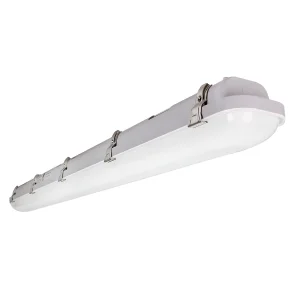
How do your IP66 and IP65 Tri-proof luminaires prevent moisture ingress?
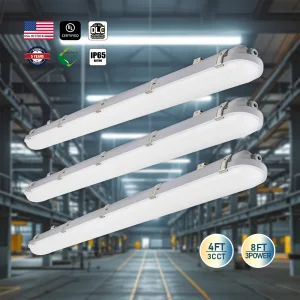
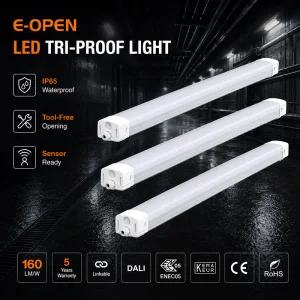
Our Tri-proof luminaires rely on custom-molded elastomeric end caps and continuous silicone gaskets, combined with high-grade polycarbonate housings produced in our injection molding workshop. This mechanical assembly is tested in our water-ingress darkrooms to guarantee reliable operations in high-humidity zones like saunas, swimming pools, food canteens, and subterranean tunnels.
What parameters are verified during your photoelectric testing routine?
Every product series undergoes testing in our integrating sphere spectrometer darkroom. We measure luminous efficacy (lm/W), total light output, correlated color temperature (CCT range including 5CCT switches), color rendering index (CRI), power factor, and voltage harmonics. This testing routine ensures that products match standard specification sheets prior to export shipping.
How does being close to Ningbo Port benefit bulk wholesale shipments?
Being located just 38 kilometers away from Ningbo Port significantly reduces inland logistics times and trucking costs. This allows us to rapidly transfer sea freight container loads from our storage facilities directly to shipping vessels. This geographic location helps lower shipping fees and shortens order delivery cycles for global buyers.