1. Executive Summary & Historical Evolution of Vintage Lighting
In the contemporary architecture and lighting design paradigm, the integration of vintage aesthetics and high-efficacy solid-state illumination has shifted from a niche interior trend into a multi-billion-dollar global procurement vertical. Originally, Thomas Edison's early carbon-filament bulbs offered warm color temperatures (approximately 1800K to 2200K) and high Color Rendering Indexes (CRI), but were constrained by low luminous efficiency (roughly 1.5 to 3 lumens per watt) and an operational lifespan of fewer than 1,000 hours. The subsequent tungsten variants improved durability but still consumed excessive energy, generating massive thermal loads that restricted their use in modern commercial spaces.
The dawn of the LED era introduced phosphor-coated sapphire chips (SMD) and high-brightness COB configurations. However, early LED replacements failed to replicate the aesthetic warmth of heritage filaments, creating a stark visual disconnect in historic preservation projects, hospitality environments, and vintage-themed retail venues. This gap catalyzed the development of the Vintage Style LED Filament Bulb. By arranging tiny LED dies along glass or sapphire substrates and coating them in custom yellow-orange phosphors, lighting engineers successfully simulated the linear, glowing filament patterns of historical lamps while achieving efficiency benchmarks exceeding 100 lm/W and lifespans surpassing 25,000 hours.
Today, as global carbon neutrality mandates (such as the European Union's Ecodesign Directive and the US Energy Policy and Conservation Act) phase out inefficient incandescent lamps, vintage style LED filament bulbs serve as the critical bridge between historical aesthetics and modern sustainability. Global distributors, large-scale commercial real estate developers, and municipal heritage agencies are increasingly sourcing high-compliance vintage LED lamps from specialized Chinese manufacturing hubs that can scale production while meeting strict environmental and technical parameters.
2. Global B2B Procurement Dynamics & The Quality Paradigm
Procuring commercial-grade vintage LED lighting systems involves navigating complex supply chains, strict regional certifications, and precise technical requirements. For a sourcing officer at a global distributor, the primary criteria extend far beyond the unit cost. A failure at the component level of a luminaire installed in a commercial project—such as a luxury hotel, a municipal park, or a retail chain—incurs significant maintenance and replacement costs that far outweigh initial savings. Under Google’s E-E-A-T (Experience, Expertise, Authoritativeness, and Trustworthiness) standards, assessing a manufacturing partner requires evaluating their material supply chains, driver engineering, and structural validation methods.
A critical challenge in vintage style LED filament bulb procurement is the driver topology. Low-cost manufacturers often employ basic resistance-capacitive (RC) step-down drivers. These drivers are prone to high-frequency stroboscopic flicker, possess low power factors (PF < 0.5), and are highly sensitive to thermal degradation, leading to early lamp failure. Authorized exporters, by contrast, utilize advanced constant-current IC drivers equipped with intelligent thermal foldback protection and active power factor correction (PFC). This ensures stable light output, low Total Harmonic Distortion (THD < 15%), and full compatibility with complex commercial dimming protocols, including Triac, 0-10V, and DALI systems.
Furthermore, global B2B procurement demands strict compliance with regional regulations. In North America, UL/cUL listing or ETL certification is mandatory for insurance and safety compliance, alongside Energy Star registration for utility rebates. In the European Union, CE marking, RoHS compliance, and GS (Geprüfte Sicherheit) certifications are required, coupled with LVD (Low Voltage Directive) and EMC (Electromagnetic Compatibility) verification. In Australia, SAA certification represents the baseline for importation. Chinese export facilities must maintain comprehensive testing logs, including LM-79, LM-80, and TM-21 reports, to assure buyers of consistent lumen maintenance and color stability over time.
| Compliance Parameter |
European Union (CE/RoHS/TUV) |
North America (UL/ETL) |
Oceania (SAA/RCM) |
| Harmonic Limits |
EN 61000-3-2 Class C Compliant |
FCC Part 15 Class B Compliant |
AS/NZS CISPR 15 Compliant |
| Luminous Efficacy |
Minimum 120 lm/W (Ecodesign) |
DLC / Energy Star thresholds |
GEMS Regulatory Requirements |
| Ingress Protection |
IP65 to IP66 (Outdoor Applications) |
Wet Location Listed (UL 1598) |
IP65 Minimum (AS 60529) |
| Impact Protection |
IK08 to IK10 Rated Housings |
ANSI C136.31 Vibration Rated |
IK08 Minimum (AS 62262) |
3. China Industry 4.0: Supply Chain Resilience & Export Efficiency
The global dominance of Chinese LED exporters is rooted in advanced industrial integration and supply chain density, often referred to as **China Industry 4.0**. In regions like Zhejiang and Guangdong, the entire manufacturing ecosystem is geographically concentrated. The integration of silicon wafer processing, phosphor synthesis, glass tube drawing, automated packaging, driver assembly, and packaging printing within tight regional clusters reduces lead times and logistics costs while accelerating prototype validation cycles.
Advanced Chinese manufacturing plants operate on vertically integrated production models. For example, maintaining an **in-house injection molding, blister molding, and compression molding workshop** allows the factory to produce lamp housings, structural end-caps, and internal diffusers on demand. This internalizes the supply chain, minimizing delays from third-party component suppliers. It also allows the factory to quickly modify structural designs to accommodate custom dimensions, custom extruded profiles, or unique thermal management configurations.
This physical manufacturing capability is supported by automated optical testing systems. Leading exporters utilize **photoelectric testing centers, darkrooms, and integrating sphere spectrometers** to record the photometric performance of every batch. By measuring color consistency, color rendering (CRI/Ra), R9 values, and initial lumen output directly on the production line, engineers can adjust phosphor mixtures and driving currents in real-time. This level of quality control is essential for producing high-stability vintage bulbs, where minor variations in filament coatings can cause noticeable shifts in color temperature across different production runs.
In addition, logistical proximity to major shipping terminals is a key driver of export efficiency. For instance, a factory located within 38 kilometers of the **Ningbo Port**—one of the busiest container hubs globally—can move completed products from the final packaging line onto container ships in less than 24 hours. This minimizes transport costs, reduces exposure to domestic logistics bottlenecks, and shortens transit times to international destinations across Europe, North America, Southeast Asia, Australia, the Middle East, and Africa.
4. Environmental Adaptation: Tri-Proof Lighting & Harsh Environments
While standard vintage LED bulbs are designed for controlled indoor environments like restaurants and hotels, commercial and industrial applications often present harsh operating conditions. Areas such as chemical storage warehouses, high-humidity food processing plants, underground transit hubs, and exposed marine docks require specialized heavy-duty lighting systems. In these settings, standard bulbs fail due to moisture ingress, dust accumulation, and chemical corrosion.
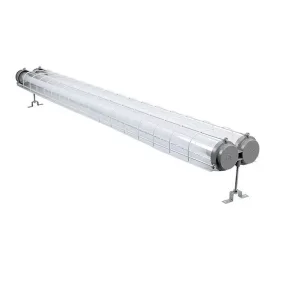
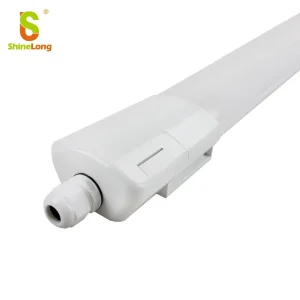
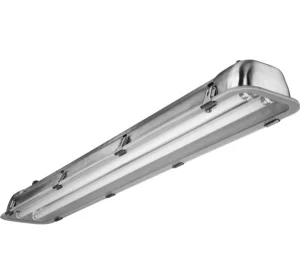
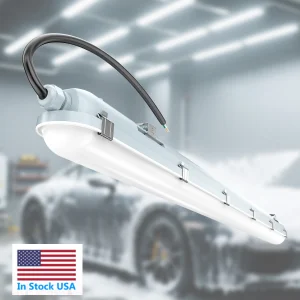
To address these challenges, manufacturers design **IP65 and IP66 Tri-proof lighting fixtures**. These units are dustproof, waterproof, and corrosion-proof, engineered to protect the inner LED arrays and drivers from environmental stress. High-grade Tri-proof housings utilize impact-resistant polycarbonate (PC) or aluminum-FRP composite materials. Combined with silicone gaskets and anti-corrosive latch systems, they maintain structural integrity under high-pressure water jets and extreme temperatures.
These advanced fixtures are designed for demanding environments, including:
- High-Humidity Facilities: Bathrooms, commercial saunas, steam rooms, industrial bakeries, and kitchens. These settings require watertight seals to prevent humidity from causing short circuits or degrading internal drivers.
- Heavy Industrial Workshops: Chemical warehouses, petroleum processing plants, coal mines, and manufacturing floors. Here, fixtures must resist corrosive chemicals and explosive gases, utilizing flame-proof housings.
- Transport & Infrastructure: Subway stations, railway tunnels, bridges, river docks, and underground parking lots. These areas require vibration-resistant components to withstand constant structural movement and continuous operational loads.
5. In-Depth Strategic Q&A (FAQ) for Global Procurement Officers
Q1: How does your factory maintain color temperature (CCT) consistency across large, recurring production batches?
We manage color consistency by sourcing LED dies from a single, top-tier packaging partner with strict binning criteria (within a 3-step MacAdam Ellipse). Our photoelectric testing center uses integrating sphere spectrometers to verify CCT and CRI values before and after final assembly, ensuring consistency across all production runs.
Q2: What design features prevent moisture ingress in your IP65 and IP66 Tri-proof fixtures?
We use double-injection molded housings with integrated high-density silicone seals and waterproof PG glands. The housings are tested in our IP waterproof level testers under simulated high-pressure washdowns to verify seal integrity before shipping.
Q3: Can your R&D team design custom profiles based on client-provided drawings?
Yes, our in-house mold R&D center can create custom extrusion dies and injection molds based on client drawings or samples. We handle prototype design, thermal simulations, and initial sample production within our integrated facility.
Q4: How does the factory manage thermal dissipation in high-wattage vintage style designs?
We fill our glass bulb housings with high-thermal-conductivity helium gas. This facilitates rapid heat transfer from the LED filament to the glass surface, lowering junction temperatures and extending the lifespan of the diodes.
Q5: What safety and environmental certifications are currently active for your export products?
Our factory operates under ISO9001:2000 quality systems and is BSCI-certified. Our lighting lines carry active certifications from TUV, GS, CE, RoHS, LVD, EMC, and SAA, meeting the regulatory standards of most global import markets.
Q6: How do your driver designs mitigate high-frequency flicker and electromagnetic interference?
Our products utilize constant-current IC drivers equipped with active EMI filtering and electrolytic capacitors rated for high temperatures. This ensures our fixtures pass all relevant LVD and EMC testing parameters, showing no stroboscopic flicker on high-speed cameras.
Q7: What logistics advantages do you offer for high-volume, time-sensitive international orders?
Our assembly plant is located 38 kilometers from Ningbo Port, allowing us to load containers and clear customs rapidly. With an annual capacity of 3 million sets, we can schedule large shipments to align with client timelines.
Q8: Do you offer material combinations like glass, plastic, or composite housings for custom configurations?
Yes. Our facility supports injection molding, blister molding, and compression molding. We can manufacture housings using PMMA, polycarbonate (PC), tempered glass, or composite materials to meet specific thermal and impact resistance requirements.
 Ledlot Lighting