Ledlot Lighting
Industrial and indoor lighting is entering a practical, human-centered phase. Factories, warehouses, offices, and retail spaces now demand more than brightness. They need visual comfort, lower energy use, safer movement, and reliable control. LED systems have become the foundation. Yet efficiency alone does not create a good lighting environment. A poorly aimed luminaire can produce glare, shadows, and worker fatigue.
The future will connect efficient luminaires with sensors, controls, and building data. Occupancy sensors can dim empty aisles. Daylight systems can reduce output beside windows. Tunable white lighting may support changing tasks, though evidence and local conditions still matter. In factories, high-bay fixtures must resist dust, vibration, heat, and frequent cleaning. In offices, measured glare control and suitable color rendering deserve equal attention. Professionals should verify performance through photometric reports, site measurements, maintenance records, and recognized safety standards. This approach reflects experience, not marketing claims.
What is the popular developing direction of modern industrial and indoor lighting? The strongest direction appears to be intelligent, connected, and human-focused lighting, supported by energy management. However, “smart” should not become a fashionable label without measurable value. A connected system may fail when software is difficult, sensors are misplaced, or staff lack training. That risk is real. Future designs should remain repairable, adaptable, and simple enough for daily use. Manufacturers, lighting designers, facility managers, and researchers must compare comfort, energy, lifecycle cost, and reliability over time. The answer is still developing. Good lighting is not merely brighter or more automated; it is a carefully tested service that helps people work safely and comfortably.
Industrial and indoor lighting describe systems that provide safe, useful, and comfortable visibility inside built environments. Industrial lighting serves factories, warehouses, workshops, processing areas, and logistics facilities. It must withstand dust, vibration, temperature changes, and long operating hours. Its purpose extends beyond visibility. It supports accurate work, safer movement, equipment inspection, and emergency response.
A poorly placed high-bay light can create glare beside a forklift route. Light is infrastructure.
Indoor lighting is broader and includes offices, schools, hospitals, homes, retail spaces, and public interiors. Each setting requires a different balance of brightness, uniformity, glare control, color appearance, and visual comfort. An office may need controlled illumination for screens and paperwork. A hospital needs clear surfaces, calm visual conditions, and reliable operation during power problems. A home usually prioritizes flexibility and atmosphere.
Measurements such as illuminance and color rendering help, but numbers alone cannot describe human comfort. The same measured brightness may feel suitable in one room and harsh in another.
The future scope will include efficient light sources, adaptive controls, occupancy sensors, and data-based maintenance. Sensors may respond to daylight, movement, or changing work conditions. Networked controls could reduce energy waste, but they also require careful setup and protection.
Maintenance remains practical: dust on a fixture can quietly reduce usable light. During site reviews, technicians should inspect shadows, reflections, access height, and worker feedback. Some assumptions will fail.
A technically correct design may still feel uncomfortable. Human experience must remain part of the definition.
Industrial and indoor lighting is moving beyond simple illumination. Key technologies are reshaping how facilities use energy, manage safety, and support workers. The International Energy Agency reported that LEDs represented more than half of global lighting sales in 2022. Their efficiency is only one advantage. Longer lifetimes, digital controls, and adjustable color output can reduce maintenance in warehouses, factories, hospitals, and offices.
Connected lighting is becoming more practical. Sensors can detect occupancy, daylight, temperature, and movement. A vacant aisle should not receive full output. The U.S. Department of Energy’s 2024 Solid-State Lighting R&D Opportunities report identifies higher efficacy, advanced controls, and improved thermal management as major development priorities. These systems can create measurable savings, but installation quality matters. Poor sensor placement still produces dark corners, nuisance switching, or wasted energy.
Human-centric lighting is also gaining attention. Tunable systems can adjust brightness and color temperature during a work shift. This may support alertness, comfort, and safer visual tasks, although the evidence remains uneven. The WELL Building Standard and recent lighting research emphasize visual comfort, glare control, and occupant experience. That broader view is useful. However, not every facility needs complex automation. A reliable photocell and properly designed optics may outperform an expensive system that staff cannot maintain. The next challenge is less about adding features and more about proving value through commissioning, measured energy data, and honest feedback.
Higher luminous efficacy means more light output from each watt of electricity. Representative values show why LED systems are becoming the foundation of modern indoor and industrial lighting, while occupancy sensors, daylight harvesting, dimming, and connected controls can further reduce energy use.
Data source: Representative efficacy ranges from the U.S. Department of Energy and ENERGY STAR lighting technology guidance. Values are shown in lumens per watt (lm/W).
What Is the Future of Industrial and Indoor Lighting?
Energy efficiency is becoming the foundation of industrial and indoor lighting. The International Energy Agency reports that lighting uses about 15% of global electricity. This figure makes every operating hour important. Modern LED systems can reduce energy use sharply, but hardware alone is not enough. The U.S. Department of Energy states that LED lighting can use at least 75% less energy than incandescent lighting and last up to 25 times longer. In a warehouse, that difference appears on monthly utility bills and maintenance schedules.
Smart lighting management adds a more practical layer. Occupancy sensors can dim empty aisles, while daylight controls adjust fixtures near skylights. A commissioning test should measure actual lux levels, response times, and unnecessary lighting hours. Small details matter. A sensor facing a moving conveyor may trigger false starts. A poorly adjusted schedule may illuminate a closed production area all night. The U.S. Department of Energy has reported potential energy savings of 20% to 60% from advanced lighting controls in commercial buildings, depending on the site and system design.
The difficult part is integration. Lighting data must support facility teams, not confuse them. Open communication standards, clear dashboards, and regular maintenance improve reliability. Energy savings should be verified against measured consumption, not assumed from product claims. The International Energy Agency also emphasizes efficiency as a central tool for reducing energy demand. Still, smart systems are not automatically smart. Human review remains necessary, especially when safety, visual comfort, and changing production patterns compete.
| Dimension | Current / Typical Value | Future Direction | Practical Impact | Reference Basis |
|---|---|---|---|---|
| LED luminous efficacy | Approximately 80–200 lm/W for commercially available LED luminaires, depending on product design, optics, temperature, and control gear. | Higher system efficacy through improved thermal management, optical design, and power electronics. | More light output from the same electrical load and lower heat generation in occupied spaces. | U.S. Department of Energy solid-state lighting performance data. |
| Incandescent replacement savings | LED lamps generally use at least 75% less energy than incandescent lamps for comparable illumination. | Accelerated replacement of inefficient legacy sources and stricter minimum-efficiency requirements. | Lower electricity consumption, reduced cooling load, and longer replacement intervals. | U.S. Department of Energy lighting efficiency guidance. |
| LED service life | Common rated life values range from 25,000 to 100,000 hours, usually specified using an L70 or equivalent lumen-maintenance metric. | Predictive maintenance based on operating hours, temperature, driver condition, and measured light output. | Fewer relamping operations and reduced maintenance disruption in high-bay and difficult-access areas. | IES and industry-standard lumen-maintenance practice. |
| Occupancy-based control savings | Typical savings are approximately 10–50%, depending on room use, vacancy patterns, sensor coverage, and control settings. | More reliable presence detection using combined motion, occupancy, scheduling, and environmental data. | Lighting operates only when areas are occupied, particularly benefiting storage rooms, corridors, and intermittently used work zones. | U.S. Department of Energy and commercial-building control studies. |
| Daylight-responsive dimming | Energy savings commonly range from approximately 20–60% in suitable perimeter zones, depending on daylight availability and commissioning quality. | Continuous dimming linked to daylight sensors, façade conditions, weather data, and glare protection. | Maintains target illuminance while reducing electric-light use near windows and skylights. | Building energy-efficiency research and daylighting control guidance. |
| Industrial high-bay lighting | LED high-bay systems commonly provide approximately 120–180 lm/W at the luminaire level, subject to specification and operating conditions. | Networked zoning, task-based illumination, adaptive dimming, and condition monitoring. | Improved visibility in production areas with lower energy and maintenance requirements. | Typical values from contemporary commercial and industrial LED specifications. |
| Indoor illuminance planning | Typical maintained illuminance targets range from about 100 lux for circulation areas to 500 lux for many detailed office or production tasks. | Task-specific lighting that adjusts output according to activity, visual requirements, and worker preferences. | Avoids both under-lighting and unnecessary over-lighting while supporting safety and visual performance. | EN 12464-1 and comparable workplace-lighting recommendations. |
| Color quality | Indoor LED products are widely available with correlated color temperatures around 2700–6500 K and color-rendering values above Ra 80; specialist applications may require higher performance. | Tunable white, improved spectral control, and application-specific color rendering. | Supports visual accuracy, comfort, wayfinding, and different operational requirements. | International lighting standards and product performance classifications. |
| Lighting control connectivity | Common architectures include wired DALI-2, 0–10 V, and relay controls, alongside wireless mesh and IP-based systems. | Interoperable, standards-based systems connected with building-management and energy-monitoring platforms. | Enables centralized scheduling, remote configuration, fault alerts, and energy reporting. | DALI-2, BACnet, KNX, and related building-automation standards. |
| Energy monitoring | Submetering can measure lighting energy by building, floor, zone, or circuit; data intervals commonly range from 1 minute to 15 minutes. | Automated measurement and verification using real-time dashboards, analytics, and anomaly detection. | Makes savings visible and identifies excessive operating hours, failed controls, and abnormal loads. | Building energy-management and measurement-and-verification practices. |
| Human-centric scheduling | Time-based scenes can schedule on, off, and dimming levels according to operating hours and occupancy patterns. | Adaptive schedules that combine occupancy, daylight, circadian-oriented settings, and user overrides. | Improves comfort and operational flexibility without requiring maximum output throughout the day. | Lighting-control and indoor-environment research. |
| Lifecycle and circularity | Lighting-system life-cycle performance depends on energy use, operating hours, maintenance, component replacement, and end-of-life treatment. | Design for repair, replaceable drivers, modular components, material recovery, and documented environmental performance. | Reduces material waste and can extend the useful life of luminaires beyond a single electronic component failure. | Life-cycle assessment principles and circular-economy guidance for electrical equipment. |
Note: Values are indicative ranges for planning and comparison. Actual performance depends on luminaire design, installation conditions, control settings, operating hours, maintenance, and applicable local standards.
Industrial and indoor lighting is moving beyond brightness. Human-centered design asks how light affects attention, comfort, sleep, and safety. In a workshop, glare-free task lighting can reduce squinting beside reflective metal. In an office, softer vertical illumination may make faces easier to read. These details matter because people experience rooms through their eyes, skin, schedules, and stress levels. Good lighting should respond to both the task and the person.
Indoor environmental quality also includes air, temperature, acoustics, materials, and control. Lighting cannot repair a poorly ventilated room. It can, however, support healthier rhythms when timing, intensity, and color shift appropriately. Daylight access remains valuable, yet it is uneven on cloudy afternoons. Sensors can adjust electric light, but automatic control sometimes feels intrusive. Manual override is a small feature with significant human value. Designers should test it with workers, not only with simulation software.
Practical evaluation needs more than a lux reading. Teams should check glare, flicker, shadow quality, eye fatigue, and complaints across different ages. Measurements should be repeated at desks, machines, corridors, and break areas. A pilot installation can reveal problems that drawings hide. Users often notice discomfort before instruments explain it. That observation deserves evidence, not dismissal. The field still overestimates perfect control. People are adaptable, but they are not lighting components. Future systems should remain efficient, repairable, and understandable, even when smart settings fail.
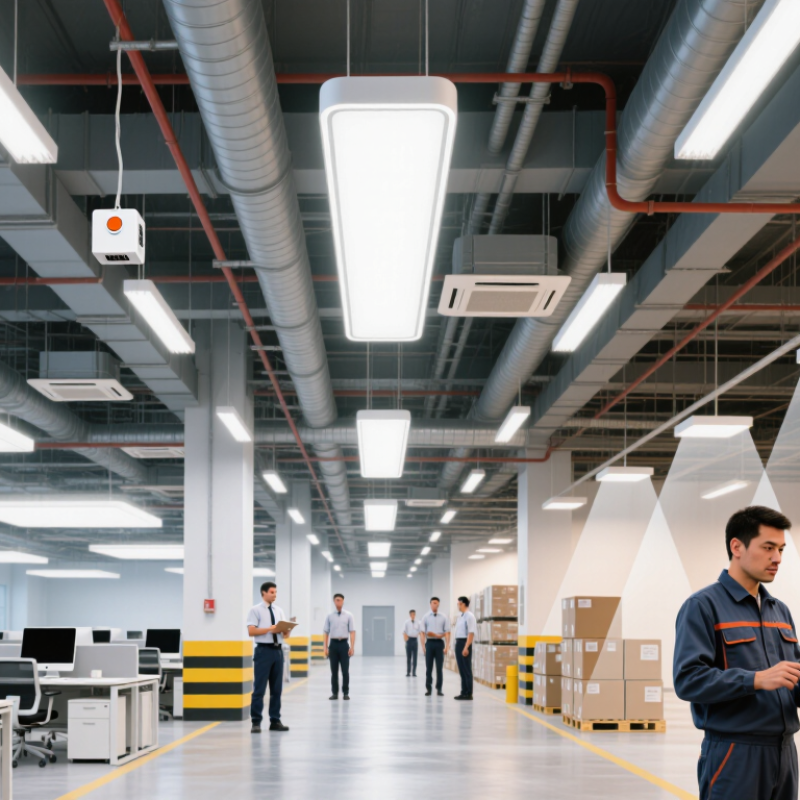
Industrial and indoor lighting is moving beyond simple illumination. Efficient solid-state fixtures, occupancy sensors, and daylight controls are reshaping factories, warehouses, offices, and healthcare spaces. Future systems will respond to movement, production schedules, glare, and changing daylight. Some will connect lighting data with building management platforms. That connection can reduce wasted energy. Small changes matter.
However, the transition is not automatic. Retrofitting a high-ceiling warehouse can involve wiring limits, dust, heat, and complex maintenance access. Poor sensor placement may leave aisles dark while empty zones remain bright. Flicker, glare, and excessive blue-rich light can affect comfort, visual performance, and sleep patterns. Safety comes first. Design teams should measure illuminance at working surfaces, uniformity, color quality, and emergency visibility. Energy savings alone cannot define success.
In manufacturing, adaptive lighting can follow assembly cells and inspection tasks. Warehouse controls can dim inactive aisles and brighten picking areas when workers arrive. Offices may combine daylight harvesting with personal task lighting. Hospitals need quieter controls, reliable backup operation, and careful nighttime settings. These applications require tested performance, not attractive promises. Engineers should review applicable standards, collect before-and-after measurements, and involve workers during pilot projects. A pilot may look perfect on paper. Real users often reveal overlooked shadows, confusing controls, or delayed responses. That feedback is inconvenient, but it improves the design. Interoperability and cybersecurity also deserve attention as more fixtures become networked. Not every connected feature earns its cost.
LED systems may use at least 75% less energy than incandescent lighting. They can also last up to 25 times longer. Actual savings vary by operating hours, fixture quality, and controls.
Occupancy sensors can dim empty aisles. Daylight controls can reduce output near skylights. These actions limit wasted lighting hours.
No. Potential savings may range from 20% to 60%, depending on the building and system design. Some estimates will be wrong.
Test illuminance, response times, operating schedules, and unnecessary lighting hours. Measure light at working surfaces. Do not rely only on software reports.
A sensor facing a moving conveyor may trigger false starts. Bad placement can leave one aisle dark while another stays bright. The layout may need revision.
Warehouse lights can brighten when workers enter picking areas. Factory systems can follow assembly cells and inspection tasks. Controls must respond quickly.
Flicker, glare, uneven illumination, and excessive blue-rich light may reduce comfort. They can also affect visual performance and sleep patterns. Safety comes first.
Use clear dashboards and compatible communication methods. Review maintenance access, backup operation, and cybersecurity. A neat dashboard can still confuse staff.
Workers may notice shadows, delayed responses, or confusing controls. A pilot can look perfect on paper. Real use often exposes weaknesses.
Industrial and indoor lighting is evolving from a basic source of illumination into an integrated system that supports productivity, safety, comfort, and environmental responsibility. Modern solutions combine efficient light sources, advanced sensors, wireless connectivity, automated controls, and data analysis to adjust brightness, color, and operating schedules according to occupancy, tasks, and natural daylight. These technologies help reduce energy consumption and maintenance requirements while improving visibility in factories, warehouses, offices, healthcare facilities, and other indoor environments.
What is the popular developing direction of modern industrial and indoor lighting? The answer is a shift toward intelligent, energy-efficient, human-centered, and adaptable lighting ecosystems. Future systems will increasingly respond to individual needs, support healthier indoor conditions, and connect with broader building management platforms. However, challenges such as installation costs, cybersecurity, system compatibility, data protection, and responsible recycling must be addressed. Overall, the industry is moving toward flexible lighting that balances operational performance, occupant well-being, sustainability, and long-term economic value.