Ledlot Lighting
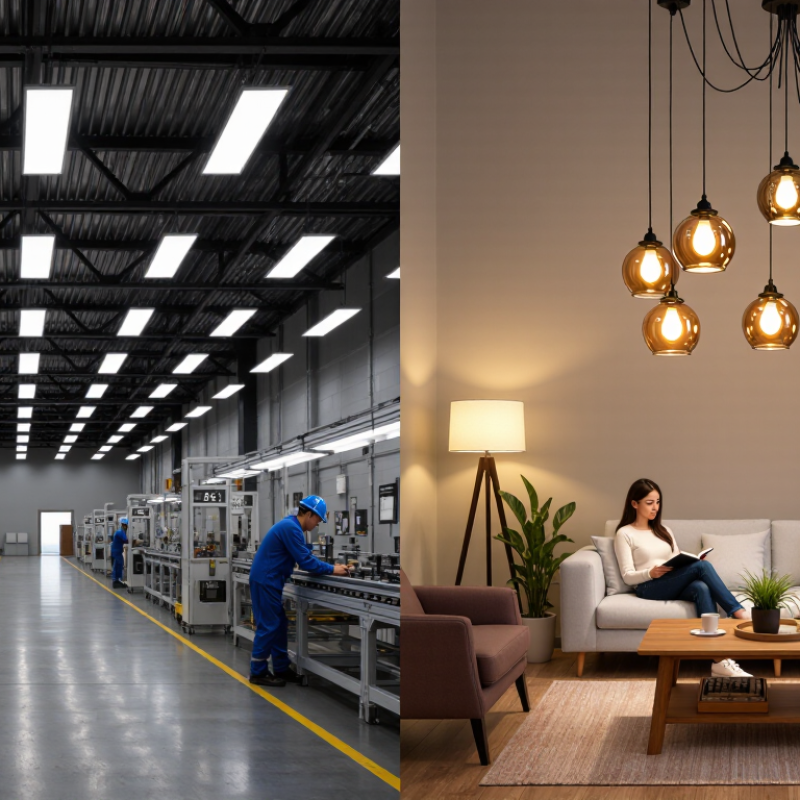
Choosing the right lighting begins with a practical question: What is the key difference between industrial and indoor household lighting? Industrial systems support safety, productivity, visibility, and equipment performance. Household systems support comfort, atmosphere, personal routines, and visual wellbeing.
The International Energy Agency reports that lighting uses about 15% of global electricity consumption. This figure makes efficiency important in both settings. However, the design priorities are different. A factory may require high uniformity, glare control, dust resistance, and long operating hours. A living room may need warm light, dimming, softer shadows, and a more welcoming appearance. Small details matter. A worker reading a control panel needs stable, low-glare illumination. Someone reading beside a sofa needs comfort, not maximum brightness.
Dr. Mariana Figueiro, a recognized lighting and circadian-rhythm researcher, has stated, “Light is the most powerful synchronizer of the human circadian system.” Her observation reminds designers that household lighting can influence sleep timing and daily energy. Industrial lighting also affects people, but its first responsibility is usually reliable task visibility and workplace safety.
The U.S. Department of Energy’s solid-state lighting reports show continuing improvements in LED efficacy and energy performance. Yet efficiency alone cannot determine a suitable product. A bright fixture may still create glare, fatigue, or wasted light. That boundary is not absolute. A home workshop may need industrial durability, while a modern factory may require warmer, human-centered lighting. The best choice considers the room, the task, operating hours, maintenance conditions, and the people using the space. Mistakes happen when appearance or wattage becomes the only decision.
Residential lighting usually begins with comfort. A 2700–3000 K lamp creates a warm, relaxed atmosphere in bedrooms, lounges, and dining areas. It resembles the softer color of sunset. This tone can make wood, fabric, and skin appear inviting. However, warm light may reduce visual sharpness during detailed work. A kitchen counter, home office, or hobby bench may need brighter, more neutral illumination. Color temperature alone does not determine quality. Check brightness, glare control, color rendering, and beam direction.
Industrial lighting starts with the task, not the room’s mood. A warehouse aisle, inspection table, and machine area require different lighting plans. Many workspaces use neutral or cool light around 4000–5000 K, but this range is not universal. Precision inspection may need excellent color rendering and even illumination. A dusty or damp area may also require suitable ingress protection. Review the task’s recommended illuminance, fixture placement, maintenance needs, and local safety requirements. A lighting professional can verify these details with a photometric assessment.
Do not simply install the brightest fixture. Excessive glare causes fatigue and can hide surface defects. I would also avoid choosing cool light only because it “looks professional.” That assumption is weak. A small workshop may work better with layered lighting: comfortable ambient light, focused task light, and controlled shadows. Real conditions matter. Test the fixture at the work surface before committing to a large installation.Winvalid
Choosing industrial or household lighting begins with energy use, not appearance alone. Incandescent lamps release much of their electricity as heat. LEDs can use up to 75% less energy while producing similar brightness. That difference matters in a warehouse with hundreds of fixtures. It also matters in a hallway used every evening. Lower consumption can reduce operating costs, although purchase price and installation still need review.
In practical lighting assessments, I compare lumens, beam angle, color temperature, and operating hours. A high-lumen LED may suit a workshop, while a softer option feels better in a bedroom. Industrial spaces often need uniform light over shelves, machinery, and walkways. Household rooms may need comfort instead. LEDs usually last much longer, but poor ventilation can shorten their life. This detail is easy to miss.
Tips: Check lumens instead of watts. Match the beam to the task. Choose suitable color temperature. Measure daily operating hours. Inspect heat around enclosed fixtures. Test one area before replacing everything. Old wiring can complicate the plan. A simple calculation helps: annual energy use equals watts multiplied by hours and operating days. The result may challenge expectations. Not every LED installation saves money immediately, especially when controls or rewiring are necessary.
At home, choose lighting with a color rendering index of at least 80. This helps skin, food, wood, and painted walls appear more natural. In a kitchen, high CRI light can reveal subtle changes in fresh produce. In a bedroom, warm color temperature may feel calmer. Check the product’s measured CRI, not only its marketing description. I once selected a bright lamp with poor color quality. The room looked dull despite its high lumen output.
Industrial lighting requires a wider performance check. Aim for 100–200 lm/W when comparing fixtures for warehouses, workshops, or production areas. Higher efficacy can reduce energy use, but it does not guarantee better visibility. Review beam distribution, glare control, flicker, heat management, and operating temperature. A narrow beam may create harsh shadows between storage racks. A well-designed fixture spreads light evenly across floors and work surfaces.
Ceiling height, dust, humidity, and maintenance schedules affect results. A fixture rated at 160 lm/W in a laboratory may perform differently after years of heat and dirt. Ask for photometric data and test one unit before large-scale installation. Also consider color consistency between fixtures. My own evaluations sometimes focus too heavily on efficiency, and that is a mistake. Workers need comfortable, stable light, not just impressive numbers.
An industrial fixture should be judged by its environment, not its attractive lumen figure. In warehouses, workshops, and loading areas, heat, dust, vibration, and long operating hours expose weak designs quickly. Industrial LEDs can reach 100,000 hours under rated conditions. That figure is not a promise for every installation. It depends on controlled temperature, correct current, and effective heat removal. A reliable specification should identify ambient limits, lumen maintenance, driver life, and testing methods. Look for documented thermal testing and recognized methods such as LM-80 and TM-21. Ask how the rating was calculated.
During a site assessment, I would inspect the mounting surface before trusting a long-life claim. A blocked heat sink or poorly ventilated ceiling can shorten service life substantially. Dust layers act like insulation. Frequent switching may also stress the driver, even when the LEDs remain cool. Check ingress protection where moisture or fine particles are present. Also compare replacement access, wiring quality, and expected maintenance intervals. These details often matter more than a bright sample in a showroom. I have seen durable fixtures underperform because installation ignored heat. That is an uncomfortable lesson.
Household lighting usually serves shorter daily cycles and cleaner rooms, so its design priorities differ. Lower initial cost may suit a bedroom, office, or living area. For industrial spaces, calculate ownership costs, including labor, access equipment, downtime, and disposal. Do not accept “100,000 hours” without reading the conditions behind it. Request test reports, warranty terms, and realistic ambient-temperature data. Write those conditions beside the promised hours during procurement.
How to Choose Industrial or Household Lighting?
Compliance should guide lighting selection, not merely appearance or price. In project reviews, I have learned that a familiar logo can create false confidence. Verify the exact model number, certificate, testing scope, and issuing organization. A UL mark may indicate evaluation against relevant safety standards in North America. CE marking supports conformity with applicable European requirements, but it is not a universal quality guarantee. DLC qualification usually relates to energy performance and eligible lighting programs. It does not replace electrical safety testing.
Check the IP rating for dust and moisture exposure. An IP65 fixture, for example, offers stronger protection against dust and water jets than an indoor-rated product. Match the rating to the real location, such as a washdown area, dusty workshop, bathroom, or dry office. Review applicable electrical, fire, building, and energy codes before installation. Requirements can vary by country, region, and building type. Ask for current test reports and installation instructions. Check wiring temperature limits, mounting methods, emergency lighting rules, and dimming compatibility. Small details matter.
Do not rely on a catalog image.
A qualified electrician should confirm the installation. I once overlooked a control-system limitation because the fixture itself appeared fully compliant. That mistake reminded me to verify the complete system, not only the lamp. Documentation can be incomplete, and product labels can be misunderstood. When evidence is unclear, pause the purchase and request clarification from the supplier or an independent testing professional.
LEDs can use up to 75% less energy for similar brightness. Savings grow across hundreds of warehouse fixtures. Purchase and installation costs still matter.
Compare lumens first. Lumens show brightness, while watts show energy use. A simple calculation uses watts, operating hours, and operating days.
Choose comfortable brightness and a warm color temperature. Light should feel calm, not harsh. Test the lamp beside the bed.
A CRI of at least 80 helps food, skin, wood, and painted walls look natural. Brightness alone can mislead you.
Compare fixtures around 100–200 lumens per watt. Also check glare, flicker, beam spread, and heat control. Efficiency is not everything.
A narrow beam may create dark shadows between storage racks. Wider, even distribution can improve floors, shelves, and work surfaces.
Yes. Enclosed fixtures, heat, dust, and poor ventilation may reduce service life. Inspect the space around the fixture.
Test one area first. Measure brightness, comfort, heat, and energy use. Old wiring may complicate the plan. Results can surprise you.
Controls, rewiring, installation, and purchase costs can delay savings. A laboratory efficiency rating may also change after years of dirt and heat. I sometimes focus too much on impressive numbers.
Choosing between industrial and household lighting begins with understanding the space and its purpose. Indoor residential areas typically benefit from warm color temperatures around 2700–3000 K, comfortable brightness, and a color rendering index of at least 80. Industrial environments, however, often require stronger task lighting, higher visual clarity, greater lumen output, and carefully selected beam angles. What is the key difference between industrial and indoor household lighting? Industrial lighting is designed for demanding working conditions, long operating hours, and specialized performance, while household lighting emphasizes comfort, appearance, and everyday usability.
Efficiency and durability are also important considerations. LED systems can use up to 75% less energy than incandescent lamps and may deliver approximately 100–200 lumens per watt in suitable industrial applications. Under rated conditions, some industrial LEDs can reach up to 100,000 hours of service. Before installation, users should verify relevant certifications and safety requirements, including UL or CE markings, DLC eligibility where applicable, suitable IP protection ratings, and local electrical codes.